LIFE IS a Journey. I have been to the far east and the far west regions of Nepal but have not crossed more than a kilometer of its international boundaries yet. Reporting is my profession. I get some opportunities to travel on assignment.
I still remember my October 2001 Kimathanka trip that also included visit to some easily accessible parts of eastern Nepal. It took me 6 days (of walking) to reach Kimathanka from Khadbaari, the district headquarter of Sankhuwasawa. This is one of the toughest trails and remotest destinations I have ever walked and reached. Shyam Prasad Niraula, a Khadbaari-based reporter with Kantipur, and a local guy named Chandra, who helped me by carrying my baggage, accompanied me in all those ‘difficult’ 10 days.
On our way to the village that borders China, we saw amazing landscapes and hardships of Nepali rural life. We experienced local lifestyle and talked with members of a unique polyandry family. Read about that journey here along with the story of a polyandry family of Kimathanka.
Neighbors and nearby villagers have started making fun of men who share their wife.
By Dinesh WAGLE
KIMATHANKA: It was beyond their imagination. The fathers could not have imagined doing what their son did. The oldest son of two fathers and a mother married two girls. The first marriage was already fixed as per the Nawa (a Sherpa cast) tradition of Kimathanka when both prospective bride and groom were kids. After a few years bride entered the groom’s house and gave birth to a daughter.
But Dawa, son of two brothers Chhindum Nawa, 38, and Rinjin Nawa, 35, and their shared wife Rishe Chyawa, fell in love with another girl. Dawa surely didn’t want to live like his fathers by sharing his wife with his brothers. Therefore, at the age of 20, Dawa fled to Kathmandu with his beloved. It takes 6 days of walk and a-day-long bus ride to reach the capital city from Kimathanka.
According to the information provided by his shocked fathers and mother who live in Kimathanka village of Sankhuwasabha district, Dawa “now works for a trekking agency in Kathmandu.” After her husband left her, the co-wife (first wife of Dawa) left the house as well. Now she lives in her natal home in the same village with their her 3-year-old daughter, the token of her relationship with Dawa that didn’t last long. (But Dawa’s first wife is still very loved in by his parents. They said: “We love her very much but what could the poor girl possibly do when her husband abandons her for another woman?”)
The polyandry tradition in Kimathanka and Ridak, the northern remote villages bordering China, is gradually vanishing. Dawa is not the first person from the same family to go against the age old tradition. Chhiring, 50, Dawa’s uncle (eldest brother his fathers) has married two wives. Chhiring has two sons and a daughter from his first wife, and two sons and two daughters from the second. According to Chhindum and Rinjin, their brother was “separated from the family when we were around 7 years old.” The trios themselves had two fathers.
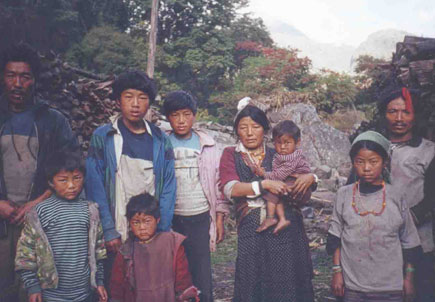
It’s not unusual in Nepali society to see a man marrying two or even three wives. The infighting between/among sautas (multiple wives of a man) is pervasive in the society. Brothers too fight while dividing their parental property during separation. But, look at Chhindum and Rinjin- the two brothers who have been sharing a wife in Rishe Chyawa. You could feel that they are not just sharing a wife but also sharing their bodies, their hearts. They even share a pipe while drink Tongwa (home made alcohol). When I was in their home to have a cup of Yak milk on October 18th, both brothers were drinking Tongwa from the same pipe as their wife sat nearby. On her lap was an infant. Other five children were around their mother. Between them was the hearth.
They were speaking the local Tibetan language. The older brother told the younger: “Brother, drink some Tongwa.” The younger replied: “I am drinking brother, you also drink.” The 41-year-old Sherpeni (wife of a Sherpa, or rather two Sherpas!) who had been getting affection from two husbands was busy feeding her kids. She was giving them Tibetan tea- mixture of salt, ghee and yak milk.
(This family’s 18-year-old second son is a 5th grader in a nearby primary school. His further education is uncertain as there is no high school nearby. The nearest one is 6-days walk away, in Khandbari, the district headquarter. Fourth child Uchhen is 6 years old, a first grader. 13-year-old daughter Chippa doesn’t go to school. “There is no one in the house to work,” told one of her fathers. The 5-year-old Yunchhuk is the 5th child and Pema, the 6th is 3 years old.)
Chhindum hardly understands Nepali language. Rinjin speaks the national language fluently. After cleaning a glass very carefully and putting fresh Yak milk on fire, Rinjin said: “We two brothers are living with the same wife.” Finally he came to the topic I was trying to talk about!
This family has 22 hybrid yaks. The environment of Kimathanka, where snow falls only 3 months a year, is not suitable for the cattles. That is why the brothers take their yaks up on the hills- in the vast terrain of high snowy hills that could be reached from their home after walking for two days. Turn by turn, these brothers take care of the yaks in the shed. It’s time of snow fall in Kimathanka. After bringing down the yaks, both brothers were relaxing by sitting together on the leather of yak and drinking Tongwa in front of their wife.
If you give attentive ear to these brothers you will know that there are certain reasons behind the polyandry tradition in this village. The farming land is precious little, and production is very much less compared to the efforts for cultivating. If all brothers marry different women that will lead to separation of the family. That, in turn, will results in the division of land. That means less food production.
While one brother goes to the hilltop to rear yaks, another lives in home with wife. By that division of labor both yaks and home are taken care of. This makes life somewhat easier also. “You can even be rich living with a shared wife,” Rinjin told as he poured the hot milk in a glass. “Property has to be divided if you live with separate wife. This makes you poor and you cant have enough food to eat.”
Among the total 48 houses of Kimathanka, 15 are polyandry families. But in at least 5 families, men have multiple wives. Kimathanka Village Development Commeete (VDC) Chairman Rijjeen Sherpas’ house could offer a glimpse into the conflicting situation. Chairman’s first son, Kin Sang, and the third, Dawa, are sharing a wife where as second Pasang is happily living with his two wives.
“This is a tradition we have followed for ages,” said Mrs. Rihse in Tibetan. How does she feel about being loved by two husbands. “Who do you love the most?” I asked her. The answer could have been different if I had asked that in the absence of both or one of her husbands. My question made her shy.
“I love both of them equally. And, they also love me very much and equally,” she said.
As she said that both her husbands who were eagerly watching her as if they were kids smiled together. I sipped the yak milk and threw another question to her. “Who do you like more?” There was a quick response from Rishe that made her husbands’ faces shine. “Both men look similar, their faces look similar to me, their habits are similar. I like both of them equally.”
The appearance could be same only if looked from Rishe’s eyes of love. What I saw is the older brother had somewhat whitish complexion, he sported a ponytail that was tied by a red thread. Younger brother looked a bit overweight, sported mustache and had dark complexion.
Thanks to the polyandry tradition the population of Kimathanka has increased by only 10 person in last 10 years. According to the 1992 National Census, the population of Kimathanka was 303. This year’s census reveals the new number as 313. On the basis of population, Kimathanka is the smallest among 4 thousand VDCs of Nepal.
Polyandry is no more a fashionable thing especially outside the village. Residents of neighboring Nepali villages like Chepuwa, Chyamtang and Hatiya laugh at the polyandry husbands. Youths who have seen the world outside Kimathanka village think its shameful to share a wife with brothers. I asked a young boy of polyandry parents about the tradition. “No, I will never do what my parents have been doing. Sharing your wife is a shameful thing.”
In the polyandry culture the older brother is the head of the family. He is also the official father of the kids even if their biological father is his brother. For example, in the citizenship, the ‘father’ of the shared wife’s children is the older brother. House and land are registered in his name. Kami Nawa, Chairman, Ward No. 6., of the VDC said: “The mother decides which children belongs to which husbands if the brothers wanted to separate.”
A question related to this made the otherwise cool Sherpeni, Rishe who was had decorated her hair with a jasmine flower, somewhat agitated. “We are living now in harmony, there is no necessity of separation,” she said curtly.
“Why do you want to know about this? Who do you think you are to ask such question?”
Probably, she was right. The milk in my glass was already finished.
This article, translated from Nepali, was first published in Nepal Magazine.
Here are photos from my Kimathanka trip


 Dinesh Wagle on Nepali Society
9 responses to “Nepal’s Polyandry Tradition: Young Men Don’t Want to Share Their Wife With Brothers in Kimathanka”
[…] first visited Dharan in 2001. I was on my way to Kimathanka, the remote and smallest village of Nepal by population bordering China. I stopped for a few days in Biratnagar, booked my air […]
[…] बर्ष अघि चीनसँगको सीमानाको सबैभन्दा सानो नेपाली गाउँ किमाथाङ्का जादा संखुवासभाको सदरमुकाम […]
तपाईंको लेख राम्रो लाग्यो ।
[…] Nepal’s Polyandry Tradition: Young Men Don’t Want to Share Their Wife With Brothers in Kimathan… A polyandry family of Kimathanka, Nepal […]
Really interesting. I never knew there where people who willingly shared wives anyway in the world, especially not in Nepal. I don’t think it is shameful, i think it is practical. If it works then great. More people should embrace living arrangements that make them happy rather then what is expected!
[…] थिएँ । मैत्री पुलभन्दा अलि माथिको एउटा सानो घरमा त्यो साँझ दुई जना दाजुभ… अझै बिर्सन सकेको छैन । अनि रिसेको […]
culture is culture, it won’t thrive if it is harmful.. good for them..
[…] Poliandri di Nepal. Beberapa keluarga mengikuti tradisi yang ada di Nepal, yaitu perempuan menikah dengan laki-laki dan saudaranya. Alam yang keras dan sulit di Nepal membutuhkan tenaga ekstra untuk dapat bercocok tanam, perempuan dengan banyak suami, terbantu karena memiliki kekuatan ekstra dalam satu keluarga. Mereka berbagi tugas. Ketika suami pertama pergi untuk menjual hasil panennya, masih ada suami kedua untuk membantu sehari-hari. Cerita lengkapnya ada di sini dan di sini. […]
Thanks sir for sharing journey experience of kimbathanka ,Sankhuwasabha & about peculiar polyandrous family.